Friday, December 25, 2009

The Recession is Over

Recalling the wisdom of grandfather B. In the 1930's with recession rampant the U. S. government under Pres. Herbert Hoover decided to rein in spending thereby greasing the skid into The Great Depression.

In many communities with plants shut down and farmers unable to sell their produce people simply ran out of money.

On every block there was a mom and pop grocery and they kept was called a "tab". The customer could buy essentials and pay as a day job or a check from a more prosperous relative was available.

A customer came in to Chestnut Street Corner Grocery one day and payed his account in full.

A few weeks later the owner encountered him on the street. I haven't see you for a while he noted.

I have a good job now. I buy my groceries at the supermarket for cash.

But why did you desert me?

Oh! Do you sell for cash too?

Tuesday, December 15, 2009

There have been many cartoons and gags about the age of magazines in doctor's waiting rooms.

Recently Jean drove a friend to the new and beautiful waiting room at the emergency room at Eisenhower Hospital.

It is a far cry from the old one where you might sit for an indefinite time next to someone squirming with a bruised limb or coughing from an unknown malady.

For those familiar, I was shocked last year that upon entering I was ushered immediately into a triage room.

Jean had called me to explain she might be there for some time so I decided to sit with her.

On the low table was a copy of the magazine, Palm Springs Life.

Flipping through I glanced at the obligatory page of the movers and shakers at a charity costume gathering.

There dressed in western garb with toy six-guns at her sides was cousin Jan.

Knowing that Jan had moved from the valley a few years ago, I checked the date.

I don't remember the exact date. I thought of tearing out the page but opted not to deface the magazine.

Unbelievably, the magazine was over twenty years old.

I don't know if there is a Guinness category. Should I have occasion to be there again in a few years and the magazine is still there I might submit it.

My suspicion is that they have a supply in the basement and by then we will be into the 90's editions.

Monday, November 23, 2009

She has been called the First Jewish Superstar.

She was a poet, a writer,a painter, an activist in Jewish causes.

Her name was Adah Isaacs Menken.

She was born in 1836 and died in Paris at the age of 33 suffering from tuberculosis and peritonitis a rabbi at her side

Married to Menken in Texas the couple moved to Cincinnati to be closer to the center of the fledgling Reform Movement of Judaism. She wrote extensively of the plight of Jews in The Ottoman Empire of Turkey.

After the death of her infant she tired of domestic life and she and Menken were divorced.

She became an entertainer and eventually gravitated to San Francisco where she was discovered by a theatre owner and cast in the lead of the popular play Mazeppa.

A key scene involved the lead character being captured by brigands and stripped naked then breaking away on a fiery steed and galloping across the stage onto a ramp built in the center of the auditorium. Usually a dummy was used but Menken conceived the idea of riding the horse herself dressed in a skin colored body suit.

When the stunt became known, the righteous people of San Francisco were outraged but on opening night all the "cool people" were there. The women in their carriages dressed to the nines and the men in their top hats and flowing capes. The play was a sell out for months. Adah was the darling of the artsy set and is reputed to have had affairs with several including the author Brett Harte.

She took the play to New York and toured the country her many affairs no secret. News of her naughty behavior preceded her fanned by her advance man who was instructed to place as many pictures of her in Main Street storefronts as he could.

After the furor in the U. S. she moved on to London and the U.K. using the same Madonalike tactics and then on to Paris where she befriended George Sands and her group and was rumored to have had an affair with Alexander Dumas.

I mentioned her sad early death but her birth remained shrouded in a variety of tales she spread.

The fact established much later in 1938 by a researcher was that she was born in New Orleans. Her mother was a Creole (of mixed race) and her father was a free African American known to be an intellectual.

It was said that she converted from a Catholic birth but she maintained she was born the first Jewish Superstar.

Thursday, October 15, 2009

Re Previous post

Saw the Mohs specialist today who informed me that Hoxsey's paste is no longer used. Patients complained that it caused to much irritation.

I will be going in for a day surgery on October 23rd to remove a basal cell cancer on the upper arch of my left outer ear.

This is a localized cancer that does not spread through the body but if not treated will continue to grow in the area it occupies.

There will be a small pit remaining where the affected tissue is removed.

If it proves too distracting to onlookers, I can have it repaired with plastic surgery.

Thanks to the doctors at Group Health who caught this early and to Medicare who will pay most of the bill.

Tuesday, October 13, 2009

In the 1940's as a 15 year old I worked summers at B. B. & S. under the tutelage of my mentor, Mr. Henderson.

Several lessons were dedicated to the stupidity of medical doctors who refused to acknowledge the genius of Harry Hoxsey, the lay doctor, former coal miner and insurance salesman, who advertised "Dr. Hoxsey's Cure for Cancer."

Hoxsey started his clinic in 1920 with a "sure cure" for any kind of cancer based on a handed down story about a horse that developed an ulcer. The animal was pastured in a field containing certain herbs. In time, the horse cured itself.

Hoxsey recreated a mixture of those herbs and teaming up with a radio announcer advertised to the world he could cure any sort of cancer.

Although he did no actual testing and tests by medical labs showed that internal use could make a patient extremely ill and in some cases cause death, by 1950 he was treating 8,000 patients a year with a revenue of $1,800,000.

A Canadian study showed that many of his "cures" did not show cancer symptoms in the first place and that a high percentage of his patients died of cancer after treatment.

He sued the AMA for slander and won. The judge awarded him $2. ruling that because most of Hoxsey's advertising was based on the idea that the AMA was persecuting him because they knew he was right and they were wrong he had suffered no monetary loss.

The Hoxsey case became a cause celebre with the top right-wing agitators of the day. Apparently Mr. Henderson subscribed to a right wing news letter and felt Mr. Hoxsey's pain and possibly sent a dollar to help the multimillionaire, Hoxsey, in his fight.

Tonight I was doing some research on treatment of basal cell cancer on the ear by the Mohs method. I was surprised to find that part of the treatment was the removal of cancerous cells using a caustic substance derived from some of the herbs used in Hoxsey's magic cure.

Well, Mr. Henderson, a lot of big lies are based on small truths.

Labels:

Wednesday, October 07, 2009

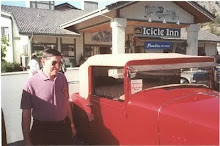
Mike posted my picture that was taken a few years ago next to a 1929 Franklin ragtop. It is not my brother's but similar. It came into the world the same year I did.

My wife put together a great 80th birthday party for me at Anthony's Homeport in Kirkland. The staff there did a job far beyond the ordinary. With forty guests including those from California and Eastern Washington as well as locals, it was a night to remember.

My boys gave me a thoughtful present, an Amazon Kindle, the adjustable size print is perfect for my diplopia.

I was just listening to a local rabble rousing talk show host rail against a possible state tax hike in these troubled times. I don't like taxes any more than the next guy but it brought to mind a story Grandfather B told me.

On arriving in this country he had worked in Philadelphia where members of his family had settled. He then migrated West where other members of his family resided in Walla Walla.

In 1921 he returned to Europe to rescue his family. On his return he stopped in Philadelphia.

Looking up an old friend he was appalled that his formerly prosperous friend was obviously having financial problems.

It seems that after WWI a brief recession had undermined the value of the scrap metal he collected door to door with his horse drawn wagon.

He said he loved his old pal but things got so bad he had to retrench. To be kind to the horse he cut it's food ration by half each week and you know what? The ungrateful animal died. The man did not have money to buy another.

Wednesday, September 30, 2009